What Do the Acronyms in Food Plant Sanitation Mean? A Field Guide for New Managers
Contract sanitation runs on acronyms. Here is how StartKleen trains new managers to speak the language of the plant and the wider industry.
TL;DR
Contract sanitation runs on acronyms like GMP, HACCP, SSOP, FSMA and ATP. StartKleen’s WINS training teaches new managers the language of their own facility and the wider industry, so they can walk onto any floor and know exactly what is being said.
Why Contract Sanitation Runs on Acronyms
For a new manager, the biggest adjustment on a food processing floor is the language. The manager’s seat comes with a wider vocabulary than the floor alone requires: regulatory bodies, audit frameworks and test results, most of it in acronyms and most of it aimed at the people a manager now has to answer to. Someone says the facility failed an ATP swab on the MCC line in the debone room, and the words only help if you already speak them. That shorthand moves fast, and a manager has to be fluent in it to lead a crew, brief a QA team and answer an inspector.
As an outsider, it’s all jargon. So how do we set our managers up for success? Not only understanding the language of their facility, but understanding the language of the industry.
Aubrey Kimbrell, Administrative Director of Compliance, StartKleen
What a manager needs is to recognize the terms fast enough to act on them, because the window to respond on a sanitation shift is short. Fluency in both the facility’s language and the wider industry’s is what lets a manager lead a crew instead of translating in their head.
The Three Kinds of Acronyms a Manager Runs Into
The shorthand sorts into three groups, and knowing which group a term belongs to matters more than memorizing any single definition. Some acronyms name the agencies that regulate the work: the FDA, the USDA with its FSIS inspectors and OSHA for worker safety. Some name the frameworks a plant is audited against: SQF, BRC, HACCP, GMP and FSMA. And some are pure floor vocabulary: a CIP cycle, a failed ATP swab or a CFU count that comes back too high.
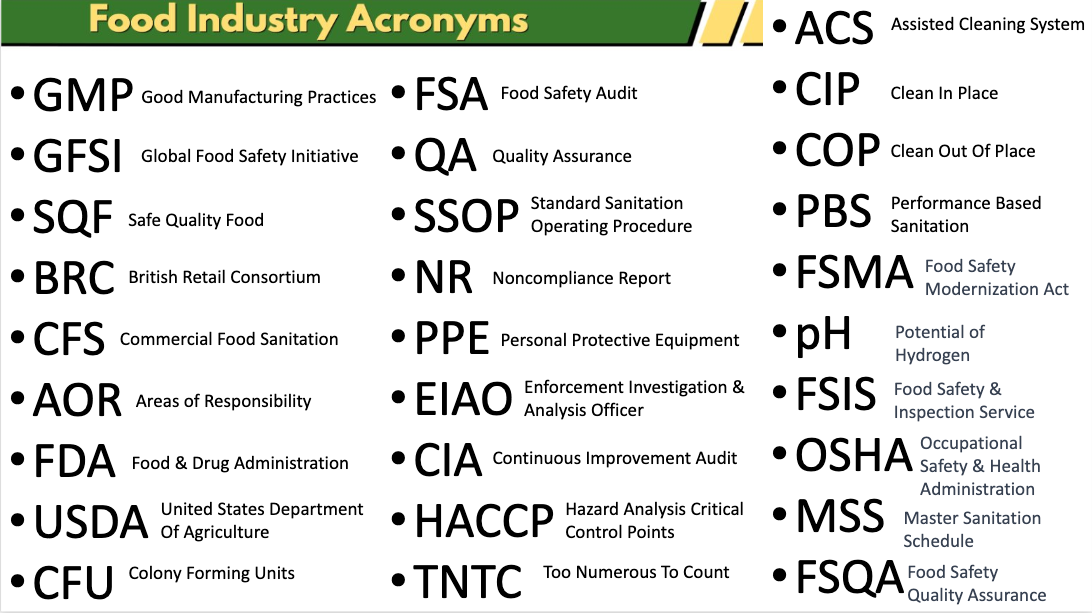
A new manager does not have to define all of them on day one. They need to recognize which world a term belongs to, so that when it comes up mid-shift they know whether it is a regulator’s requirement, an audit standard or a step their own crew owns. That instinct is what training builds. The full list is at the bottom of this post as a quick reference.
How StartKleen Trains Managers to Speak the Language
StartKleen builds industry fluency into a manager’s onboarding. The company’s approach runs through WINS, its internal leadership program, where managers nominated for their potential, many of them promoted from within, get oriented as they step into leadership. The training is presented in English and Spanish, and the vocabulary is part of it from the start.
StartKleen frames the acronyms as a working cheat sheet its managers can pull out when they need it. The company is also clear about where its role ends:
We’re not the ones who titled this and defined it and did the research on it. But we are the people who train our managers on what it is. Here’s your cheat sheet, here’s your resource to make the acronyms a little less scary.
Aubrey Kimbrell, Administrative Director of Compliance, StartKleen
WINS covers the foundations a manager needs to speak with authority: a sanitation overview and history, the four parts of cleaning, the acronyms themselves, GMPs and the seven steps of sanitation. Those seven steps are built into the company’s identity, with seven water drops in the StartKleen sunburst, and that was intentional. Site managers go deeper through the Site Manager Master Training course, which puts them in groups to run study sessions and covers everything from customer communication to walking a new hire through the seven steps.
The reason we teach vocabulary in WINS is because I don’t want our managers sitting in a meeting nodding like they understand when a customer starts throwing out all these acronyms. They’re just going to understand the conversation a little better.
Rick Kimbrell, CEO & Founder, StartKleen
What Fluency on Day One Means for Your Plant
For a plant that hires a contract sanitation partner, a manager who already knows the terminology can respond the moment something comes up on the floor. When an inspector references an NR, when QA flags a CFU count or when an area fails an ATP swab before production, there is no lag while someone works out what the term means. The manager acts, and on a sanitation shift the clock between the end of cleaning and the start of production is unforgiving.
Fluency also builds credibility. A manager who can talk through GMPs and the seven steps of sanitation with a plant’s QA team is easier to trust with the floor, and a manager who can walk a brand-new hire through those same terms shortens the distance between first shift and contributing crew member. That is the return on teaching the language early. Any single acronym is small. Together they build a team that understands its own work and can prove it.
Frequently Asked Questions
The questions new managers ask most about food plant sanitation acronyms.
What is the difference between GMP and HACCP?
GMP (Good Manufacturing Practices) describes the baseline conditions and practices required for safe food production, such as facility cleanliness and worker hygiene. HACCP (Hazard Analysis Critical Control Points) is a preventive system that identifies specific food safety hazards and sets controls at critical points in the process. GMPs are the foundation; HACCP is the targeted hazard-control plan built on top of it.
What training do contract sanitation managers need?
Contract sanitation managers need to understand food safety fundamentals (GMPs, HACCP and the roles of agencies like the FDA, USDA and FSIS), facility-specific procedures and the core sanitation process, often taught as the seven steps of sanitation. At StartKleen, managers learn this through the WINS leadership program and, for site managers, the Site Manager Master Training course.
How does StartKleen train managers on industry terminology?
StartKleen teaches industry vocabulary as part of its WINS training, presented in English and Spanish, covering the acronyms, GMPs, the four parts of cleaning and the seven steps of sanitation.
What does an ATP swab test measure in a food plant?
An ATP swab measures surface cleanliness by detecting organic residue left after cleaning. A failed swab signals that an area needs to be recleaned before production can start, which makes it one of the most common real-time checks a sanitation crew acts on.
Sanitation Acronyms: A Quick Reference
Keep this as a cheat sheet. These are the acronyms a new contract sanitation manager runs into most, grouped by the three worlds above: the agencies that set the rules, the frameworks that audit against them and the terms crews use on the floor.
Agencies and oversight
| Acronym | Full name | What it means |
|---|---|---|
| FDA | Food and Drug Administration | The federal agency that regulates most food, drugs and related products. |
| USDA | United States Department of Agriculture | The federal department overseeing agriculture, including meat and poultry safety. |
| FSIS | Food Safety and Inspection Service | The USDA branch that inspects meat, poultry and egg products. |
| OSHA | Occupational Safety and Health Administration | The federal agency that sets and enforces workplace safety rules. |
| EIAO | Enforcement Investigation and Analysis Officer | A specialized food safety inspector who conducts in-depth facility reviews. |
Frameworks, audits and certifications
| Acronym | Full name | What it means |
|---|---|---|
| GFSI | Global Food Safety Initiative | An industry body that benchmarks food safety standards worldwide. |
| SQF | Safe Quality Food | A GFSI-recognized certification program for food safety and quality. |
| BRC | British Retail Consortium | A GFSI-recognized global standard for food safety and operations. |
| HACCP | Hazard Analysis Critical Control Points | A preventive system that identifies and controls food safety hazards. |
| GMP | Good Manufacturing Practices | The baseline conditions and practices required for safe food production. |
| FSMA | Food Safety Modernization Act | The 2011 law that shifted food safety toward preventing problems, not just reacting. |
| SSOP | Standard Sanitation Operating Procedure | The written, facility-specific procedure for how an area gets cleaned. |
| MSS | Master Sanitation Schedule | The schedule tracking when every area and machine is cleaned. |
| NR | Noncompliance Report | The document an inspector issues when a requirement is not met. |
| FSQA | Food Safety Quality Assurance | The combined food safety and quality assurance function at a plant. |
On the floor
| Acronym | Full name | What it means |
|---|---|---|
| CIP | Clean In Place | Cleaning equipment internally without taking it apart. |
| COP | Clean Out of Place | Cleaning by disassembling equipment and washing the parts separately. |
| PPE | Personal Protective Equipment | Gear like gloves, boots and eyewear that protects workers. |
| CFU | Colony Forming Units | A count of viable microbial cells in a sample. |
| TNTC | Too Numerous to Count | A lab result meaning the microbial count is beyond a countable range. |
| pH | Potential of Hydrogen | A measure of how acidic or alkaline a solution is. |
About the Author
Rick Kimbrell is the Founder and CEO of StartKleen. A third-generation food safety professional, Rick founded StartKleen in 2009 building on a family legacy in sanitation that began with his father, Ray Kimbrell. With more than 30 years of leadership experience in food plant sanitation, Rick has built StartKleen into a 1,500-person team supporting 200+ USDA- and FDA-regulated food processing facilities across the United States. He is a 2026 EY Entrepreneur Of The Year Southwest finalist and a Vistage Lifetime Achievement Award recipient.
Methodology
This post reflects StartKleen’s training practices for new managers, drawn from the company’s WINS leadership program and internal onboarding materials. Acronym definitions reflect standard, publicly available industry usage.
Sources & Further Reading
- StartKleen WINS Leadership Program (startkleen.com)
- U.S. Food and Drug Administration, Food Safety Modernization Act (fda.gov)
- USDA Food Safety and Inspection Service (fsis.usda.gov)
- Global Food Safety Initiative (mygfsi.com)
About StartKleen
StartKleen is a contract sanitation company serving food processing facilities across the United States, supporting 200+ USDA- and FDA-regulated plants with sanitation, food safety and workforce training.